Tariff Troubles - Trade turmoil
- nirvaankhanna2011
- Apr 6, 2025
- 7 min read
In the last week, the world has been hit by another policy decision by the US Government that has left people shaking their heads in disbelief. My family has been talking about the consequences of the trade policy of the US on the global economy a lot. While we indulge in jokes and memes from time to time about politics in general, this time the humour seemed to dry up. Hearing so much about deficits, surpluses and retaliation made me want to understand the issues fully, especially as this event looks like it will loom large not just at this moment but for the foreseeable future.
On 3rd April 2025, President Trump announced his new plans for tariffs on almost every single country worldwide. These include nations like Myanmar who are struggling to recover from devastating earthquake damage and Sri Lanka and Pakistan who are already struggling with debt and only scraping by on IMF loans. The ramifications of these actions threaten to be devastating, with the stock market crashing and protests springing up across the US opposing the Trump administration. The stock markets are already feeling the burn with the S&P 500 down over 10% and a similar impact being felt across global markets. Trump’s actions have already been criticised by many economists and financial professionals. Legendary economist Thomas Sowell, senior of the Hoover Institution stated that the Trump administration threatens to repeat the “devastating history” of trade policies that worsened the Great Depression in the US. Former Treasury Secretary Larry Summers stated that “There is no coherent logic to these policies” and also, “The best estimate of the loss from tariff policy now is (sic) closer to $30 trillion or $300,000 per family of four”. Also, Jeremy Siegal, head of Wharton economics called Trump’s tariffs the ‘biggest policy mistake in 95 years’. Jordi Gual, another famed economist and former chair of CaixaBank said “In economic terms, it makes no sense at all”. The general consensus surrounding the tariffs imposed by the United States is that the impacts will be devastating for all citizens globally.
Given the impact this announcement on tariffs has had, I thought it would be worthwhile to try and understand the issues at hand and the impact it might have on global trade, international relations and on ordinary people all over the world.

A tariff is a tax that is imposed on a product that has been imported from a foreign nation. The tax for the tariff is paid by the importers - for example, a company paying a tax on a material which they need imported from another country. The impact of this tax is that the importing companies often end up increasing their prices to match the growing importing costs, leading to expensive everyday prices for the consumers, otherwise known as inflation. There are different types of tariffs, and the one which President Trump has implemented in the US is called a reciprocal tariff. A reciprocal tariff is implemented as a response to another nations tariff on your own country, it is used as a tool for retaliation and can often lead to a back and forth trade war between nations. President Trump claims that his tariffs are a way to get back at countries that have taken unfair advantage of the United States for decades, when it comes to trade.
However, the purpose and value of a tariff (if implemented correctly) is not entirely flawed. Tariffs allow nations to protect local businesses from international competition, encouraging self reliance in the economy and enabling local businesses to establish a firm footing without being out-manoeuvred by better resourced foreign players. They act as a source of revenue for governments that may have limited alternative sources of tax income. Also, they serve as a method for countries to reduce their trade deficit with other nations as they discourage imports, which President Trump claims to be his main goal with these tariffs. He believes that the United States has been treated unfairly in international trade for a long time, and he argues that the tariffs that other nations impose on US goods are far higher than those imposed by the US on their goods.
However, tariffs are definitely not all good, and those that have been implemented by the US violate rules implemented in the GATT (General Agreement on Tariffs and Trade) and the WTO (World Trade Organisation). Tariffs can lead to significant increases in prices of basic needs and also can cause trade wars and retaliation, which can have negative economic impacts on both parties of the trade war. In the case of the United States, both of these repercussions are already visible, as China has already imposed retaliatory tariffs on the US and price increases are likely across all industries. The GATT and WTO both encourage the reduction of tariffs and the introduction of more free trade agreements between countries. The immediate US tariff increases violate the laws protecting both sudden tariff increases and the amount that the tariffs can be raised.
The concept of free trade was introduced by a Nobel winning economist named Milton Friedman, suggesting that Free Trade would be beneficial for all parties involved as it would encourage local innovation and creativity while also allowing countries to have access to a variety of international goods. While free trade may be an effective solution, the impact may not be entirely positive. The introduction of free trade would largely be beneficial for consumers, as international powerhouses swoop in and take advantage of new larger markets. However, this would mean that local businesses would struggle to get up and running as international competition takes them out of business. Perhaps fostering a local economy would be easier with the protection of small tariffs rather than none at all. Even so, there is no doubt that the concept of free trade would have several benefits for globalisation. Countries could perhaps choose to apply tariffs specifically to certain sectors that might be important to the local economy or in sensitive sectors such as defense but largely, a low tariff, free trade regime applied in a multilateral fashion, has proven to be beneficial to promoting globalisation and development.
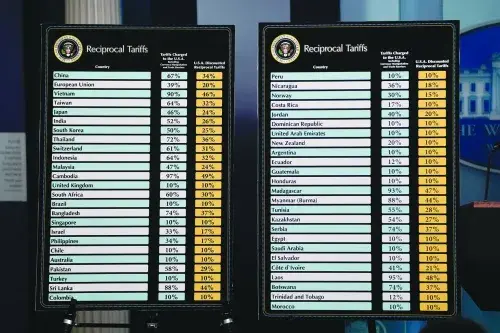
So, how did President Trump decide the rates for these tariffs? This is a question that has been playing on everyone’s minds ever since they were announced. The truth is actually far more simple than one would imagine, especially for a matter of such global importance. The Trump administration has calculated the tariffs that other nations have implemented on the US and divided them by two to come up with the reciprocal tariff that the US would apply to each country. The only problem - the tariffs that the US claimed had been implemented on their goods had no basis in fact. The Trump administration calculated the tariffs imposed by other nations on the US by taking the trade surplus that a nation had with the US, and dividing it by the total imports of the US from that country. Take the example of China, in 2024, China had a trade surplus of 295.4 billion dollars with the US, and their total exports to the US was approx. 438 billion dollars worth of goods. That creates a ratio of roughly 67-68% which is then divided by two to get the tariff rate of 34% that the US would impose. In fact these rates have been applied over and above previously imposed tariffs (leaving China effectively at 54%) and even when countries have been net importers from the US, a 10% tariff has been applied. These calculations had no mention of tariffs themselves in the equation leading to a tariff rate that is simplistic and child-like in its formulation, with none of the nuance that would be expected for such a globally important decision. Trump’s justification for this formula was that it meant balancing the deficit in the trade between the US and foreign nations. However, is this imbalance necessarily a bad thing?
If you look at it closely, all a trade deficit means is that your country relies on goods from other countries more than they rely on goods from yours, which in theory, is not always bad, especially for a rich nation like the United States which imports goods from other nations for a variety of basic needs, making it the biggest importer of goods worldwide in 2024. Additionally, applying a blanket tariff on a country with which you have a trade deficit means that the items which citizens rely on from those countries will become more expensive. As I mentioned earlier, if the US Trade Department had taken the time to analyse different businesses and then applied tariffs on specific industries, perhaps his outcome would have been more reasonable. Specific tariffs would have allowed him to protect the necessary local industries while also allowing products that his nation relies on to stay at a reasonable price.
The imposition of tariffs by the United States has already had major repercussions on the US and global economies. The announcement of the tariffs sent the global markets into a vicious 2 day sell-off according to CNBC. The market responded by investors selling everything other than bonds which pose no risk whatsoever. After all, who could predict how much to invest in a stock market which is as volatile as this one. Global trade will also be hugely impacted, with many economists predicting that the US could see a recession by the end of the next year. They also stated that they estimated that the announcement could bring the US GDP down by 2-4%. The market is in turmoil, however, is that turmoil indefinite? Most experts think not, claiming that the US economy will eventually bounce back, however, the global economy will have lost trust in US markets and predictability of US political decision making for the foreseeable future. Global trade and globalisation will continue to thrive however, with economists stating that the trade partners of the US will find ways to work around the barriers, forming new alliances in the process.
As a whole, the Trump administration has administered devastating sweeping tariff rates on almost all nations which threatened devastating impacts on global trade. There have already been impacts like the stock market crashing with the S&P 500 down almost 6%. Trump’s decisions have already violated the rules imposed by the WTO and the GATT when it comes to the imposition of tariffs. The sweeping tariffs have been classified as childish by most economic and financial professionals and the method of calculation blatantly overlooks the nuances and considerations required when it comes to international trade. The international economic impact is already severe, and threatens to create a long period of uncertainty in financial markets and a trust deficit that could take the US a long time to recover from. President Trump’s impulsive actions have already threatened to make waves in international markets, however, will the global economy find a way to bounce back?


Well presented thoughts! Keep up the good work NK !
A really insightful and well-articulated piece, Nirvaan—thank you for breaking down such a complex issue with clarity, depth and simplicity. It’s striking to see how one country’s policy decisions impacts today’s interconnected world. It makes me wonder how nations like ours—India—might navigate the fallout from such sweeping US tariffs. In this global village, no economy is truly isolated. Would love to see a follow-up exploring how emerging economies are responding and adapting to these global shifts. Keep the Inquiry more on :) Best wishes ahead, Dr. Rima Puri
Great insights. As an economist, think Also whether the US trade deficit with each country is small or large, short or long run, whether their exports and imports are from LEDC"s or MEDC's, or exports are primary or manufactured goods and services, whether exports and imports are elastic or inelastic....consider all this.....you can widen your economics knowledge beyond what all textbooks say. Unlimited knowledge production and multiple perspectives............mind goes mad.
But appreciate your zeal for real life subject (economics) at this level....keep it up.
Well researched! You helped me understand this better!
Very well researched and written Nirvaan..great job